Electric vs Petrol Delivery Motorcycles: Fleet Costs and Efficiency Guide
Electric or petrol delivery motorcycles: which makes more sense for your business? Compare energy expenses, maintenance, charging requirements, and total ownership costs with illustrative scenarios for fleets of 1, 5, and 10 motorcycles.
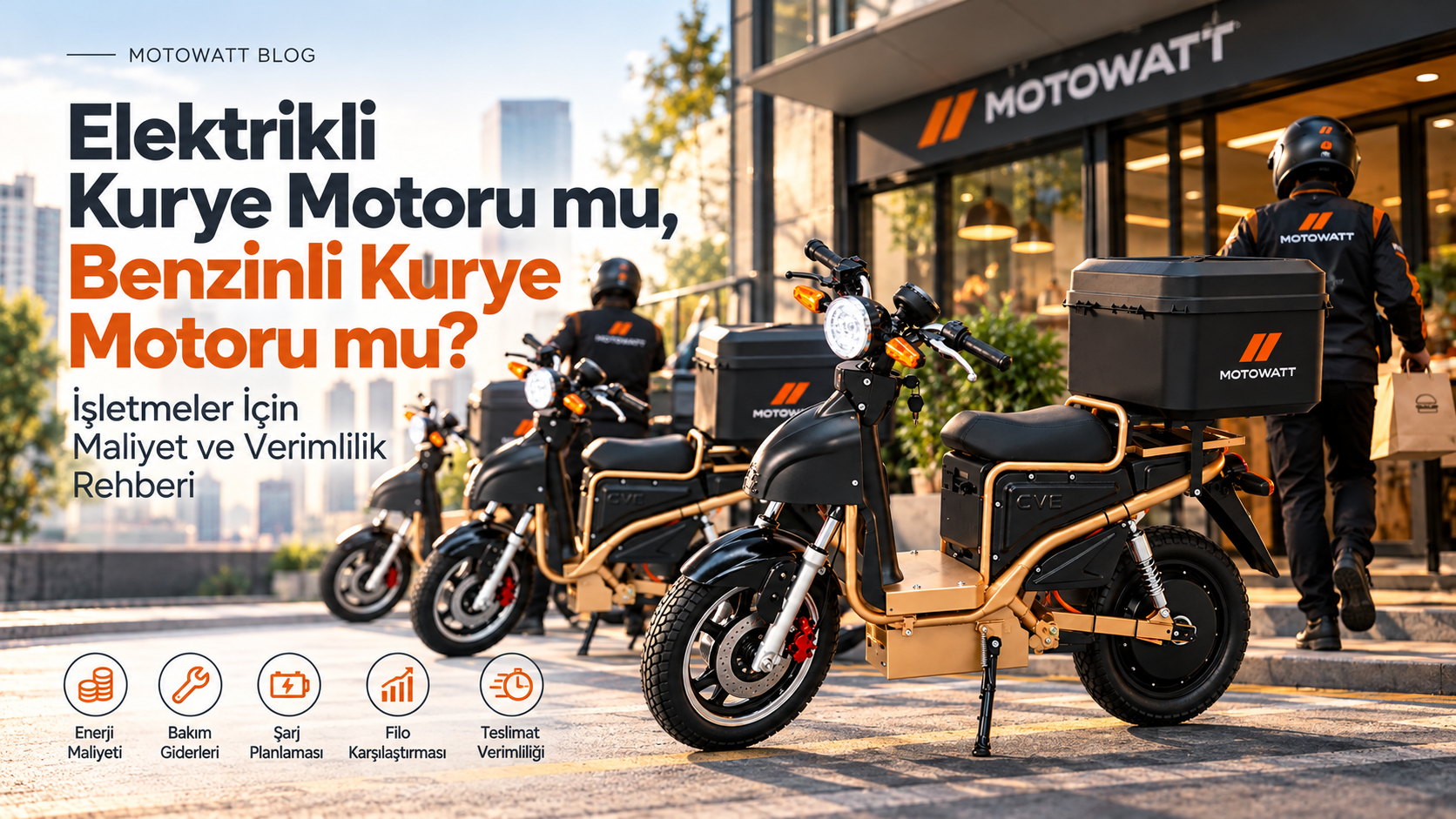
Choosing the right delivery motorcycle affects more than the initial vehicle purchase price. For restaurants, grocery stores, e-commerce businesses, and professional courier operators, the decision can influence daily expenses, delivery schedules, and overall fleet efficiency.
Electric delivery motorcycles are becoming an option for businesses seeking to manage energy costs and organise urban delivery operations. Petrol motorcycles, meanwhile, offer familiar refuelling routines and operational flexibility.
But which is better for a delivery business: an electric or petrol motorcycle?
In this guide, we compare energy costs, maintenance, charging requirements, and total cost of ownership, including illustrative calculations for fleets of 1, 5, and 10 motorcycles.
What Is an Electric Delivery Motorcycle?
An electric delivery motorcycle uses an electric motor powered by energy stored in a rechargeable battery.
It may be suitable for urban deliveries, local distribution, and routes where daily distances and charging opportunities can be planned.
However, not every electric motorcycle is suitable for every delivery operation.
Businesses should evaluate:
-
Daily riding distance
-
Real-world range
-
Cargo capacity
-
Charging time and infrastructure
-
Service and spare parts support
-
Vehicle classification and applicable regulations
-
Total cost of ownership
The right motorcycle should fit the business's actual delivery requirements.
Electric vs Petrol Delivery Motorcycles: Key Differences
| Feature | Electric Delivery Motorcycle | Petrol Delivery Motorcycle |
|---|---|---|
| Energy source | Rechargeable battery | Petrol |
| Energy expense | Depends on electricity consumption and tariff | Depends on fuel consumption and petrol price |
| Energy replenishment | Requires charging time | Refuelling is generally quicker |
| Motor maintenance | Avoids certain conventional engine maintenance tasks | May require oil changes and other engine servicing |
| Riding range | Depends on battery and operating conditions | Depends on tank capacity and fuel consumption |
| Tailpipe emissions | No tailpipe emissions during operation | Produces tailpipe emissions |
| Operational planning | Charging access and schedules are important | Access to petrol stations is important |
| Purchase cost | Varies by model and battery configuration | Varies by model and equipment |
This comparison is general. Individual models may differ significantly.
1. How Much Does an Electric Delivery Motorcycle Cost to Run?
Electric motorcycle energy costs depend on electricity consumption and the price of electricity.
The basic formula is:
Electricity cost per 100 km = Consumption (kWh/100 km) × Electricity price (TRY/kWh)
Consider a hypothetical example:
-
Electricity consumption: 5 kWh/100 km
-
Electricity price: TRY 4/kWh
-
Daily riding distance: 100 km
The calculated electricity cost is:
5 × 4 = TRY 20 per 100 km
These are illustrative values, not current electricity tariffs or verified consumption figures for a specific Motowatt motorcycle.
Actual costs may vary because of charging losses, electricity tariffs, weather, cargo weight, and riding conditions.
2. How Much Does a Petrol Delivery Motorcycle Cost to Run?
Petrol costs can be estimated using fuel consumption and the price per litre.
Petrol cost per 100 km = Consumption (litres/100 km) × Petrol price (TRY/litre)
For example:
-
Petrol consumption: 3 litres/100 km
-
Petrol price: TRY 55/litre
The calculation is:
3 × 55 = TRY 165 per 100 km
The petrol price in this example is a hypothetical input, not a claim about current fuel prices.
3. Monthly Fleet Cost Comparison: 1, 5 and 10 Motorcycles
For businesses, monthly fleet expenses are often more meaningful than a single 100 km calculation.
Assume each motorcycle covers 2,000 km per month.
Illustrative assumptions:
-
Monthly distance: 2,000 km per motorcycle
-
Electric consumption: 5 kWh/100 km
-
Electricity price: TRY 4/kWh
-
Petrol consumption: 3 litres/100 km
-
Petrol price: TRY 55/litre
| Fleet Size | Monthly Electricity Cost | Monthly Petrol Cost | Illustrative Difference |
|---|---|---|---|
| 1 motorcycle | TRY 400 | TRY 3,300 | TRY 2,900 |
| 5 motorcycles | TRY 2,000 | TRY 16,500 | TRY 14,500 |
| 10 motorcycles | TRY 4,000 | TRY 33,000 | TRY 29,000 |
In this hypothetical scenario, the difference in monthly energy expenses for a 10-motorcycle fleet is TRY 29,000.
However, this is an energy cost comparison only, not a calculation of net savings or business profit.
Vehicle purchase prices, financing, maintenance, battery costs, insurance, charging infrastructure, downtime, and resale values are not included.
If the electricity consumption figure represents battery output rather than electricity drawn from the grid, charging losses may increase the actual electricity bill.
Businesses should use their own operating data for investment decisions.
4. Maintenance Costs for Electric Delivery Motorcycles
Electric motorcycles can avoid certain maintenance tasks associated with internal combustion engines.
For example, conventional engine oil and spark plug replacement are generally unnecessary for an electric motor.
However, electric delivery motorcycles still require attention to:
-
Brakes
-
Tyres
-
Suspension
-
Steering components
-
Charging connections
-
Electrical systems
-
Model-specific drivetrain components
-
Cargo box mounting hardware
Intensive delivery use can increase wear on certain components.
Therefore, lower motor-related maintenance requirements do not guarantee a specific reduction in total servicing costs.
For more information, see our Electric Motorcycle Maintenance Guide.
5. Charging Time and Daily Delivery Planning
Charging is one of the most important operational considerations when selecting an electric delivery motorcycle.
A manufacturer's stated range does not necessarily represent the distance achievable in every delivery environment.
Real-world range may be affected by:
-
Riding speed
-
Frequent acceleration and stopping
-
Cargo weight
-
Road gradients
-
Ambient temperature
-
Wind
-
Tyre pressure
-
Battery condition
For example, if a business requires a motorcycle to travel 120 km each day, it should assess whether the chosen vehicle can reliably complete that distance under its actual working conditions.
Charging during breaks, scheduled vehicle changes, or other operational arrangements may help, depending on the fleet.
The important question is not simply “How far can this motorcycle travel?” but “Can this motorcycle complete our daily delivery schedule?”
6. Planning Charging Infrastructure for a Delivery Fleet
Charging infrastructure becomes particularly important when operating multiple electric motorcycles.
Businesses should consider:
-
Do motorcycles return to the same location after each shift?
-
Can vehicles remain parked overnight?
-
How many motorcycles need to charge simultaneously?
-
Can the existing electrical installation support the planned charging demand?
-
Which charging equipment does the manufacturer approve?
-
What happens if a charger fails or electricity becomes unavailable?
Qualified electrical professionals should assess the suitability of charging installations.
The most practical arrangement depends on vehicle specifications, parking facilities, and working schedules.
7. Total Cost of Ownership for Delivery Motorcycles
Purchase price alone does not determine which motorcycle is more economical.
Total cost of ownership (TCO) considers the expenses associated with operating a vehicle over a defined period.
A simplified approach is:
TCO = Purchase and financing costs + Energy expenses + Maintenance and repairs + Insurance and other required expenses + Charging infrastructure + Downtime costs − Residual vehicle value
Relevant taxes and accounting treatment may also need to be considered.
An electric motorcycle may have lower energy expenses while requiring a different initial investment or charging arrangement.
Businesses should compare vehicles over their intended ownership period rather than focusing on a single cost item.
8. When Does an Electric Delivery Motorcycle Pay for Itself?
If an electric motorcycle requires a higher initial investment than a comparable petrol model, a simple payback calculation can help estimate when the additional investment might be recovered.
Payback period (months) = Additional initial investment / Monthly net operating cost advantage
For example:
-
Additional initial investment: TRY 30,000
-
Estimated monthly net operating cost advantage: TRY 1,500
The calculation is:
30,000 / 1,500 = 20 months
This is a hypothetical scenario.
Actual payback depends on purchase prices, financing, maintenance, battery-related expenses, energy costs, usage intensity, and resale value.
If the monthly net advantage is zero or negative, this simplified calculation does not produce a positive payback period.
9. Which Businesses Could Benefit from Electric Delivery Motorcycles?
Restaurants and Food Delivery Businesses
Restaurants operating within a defined delivery area may find it easier to predict daily riding distances.
If motorcycles return to the restaurant between shifts, charging arrangements may also be easier to organise.
Grocery Stores and Local Retailers
Local grocery delivery operations should evaluate route lengths, delivery frequency, and cargo requirements.
The chosen motorcycle must have suitable carrying capacity and range for the intended work.
E-Commerce and Last-Mile Delivery Companies
Last-mile distribution businesses often focus on route efficiency and cost per delivery.
Electric motorcycles may be worth considering where their range, payload, and charging requirements align with the operating model.
Professional Courier Fleets
Larger fleets need to consider more than individual vehicle expenses.
Charging capacity, servicing, replacement vehicles, and operational continuity can all affect fleet performance.
10. How Should Businesses Evaluate Motowatt Models?
Motowatt offers electric motorcycle options aimed at urban and delivery applications.
When comparing models such as Motowatt Model 120, Model 250, and Model 350, businesses should review the latest official specifications and commercial terms.
Important considerations include:
-
Published range information
-
Battery capacity and charging requirements
-
Permitted payload
-
Maximum speed and vehicle classification
-
Service and warranty terms
-
Suitability for the planned daily route
-
Purchase and operating costs
Published range figures should not be treated as guaranteed real-world distances under every riding condition.
The most suitable model depends on the business's actual operating requirements.
11. How to Choose the Right Motorcycle for Your Delivery Business
Before purchasing vehicles, document your operating needs.
Ask:
-
How many kilometres does each motorcycle travel daily?
-
What is the maximum distance on a busy day?
-
How much cargo is carried?
-
How much charging time is available?
-
Where are vehicles parked?
-
What service support is available?
-
How long will the business keep the vehicles?
-
What is the total investment and operating budget?
These answers will support a more meaningful comparison than purchase price or advertised range alone.
Conclusion: Electric or Petrol Delivery Motorcycles?
Electric delivery motorcycles may be an attractive option for businesses with predictable routes, suitable charging facilities, and operating requirements that match the vehicle's capabilities.
Petrol motorcycles may offer advantages for highly variable routes, limited charging access, or operations requiring rapid refuelling.
The best choice is the motorcycle that meets the business's delivery requirements at an appropriate total cost of ownership.
Explore Motowatt's electric delivery motorcycles to assess options for your business.
Frequently Asked Questions
Are electric delivery motorcycles cheaper to operate?
They may offer lower energy expenses in certain scenarios. However, total operating costs also depend on purchase price, maintenance, battery expenses, charging infrastructure, and other factors.
How far can an electric delivery motorcycle travel per day?
The achievable distance depends on the model, battery capacity, riding conditions, and charging opportunities. Published range figures should be evaluated alongside real operating requirements.
Are electric delivery motorcycles suitable for restaurants?
They can be suitable when daily routes, cargo capacity, and charging arrangements match the restaurant's needs.
Do electric delivery motorcycles cost less to maintain?
They generally avoid some maintenance tasks associated with petrol engines. However, tyres, brakes, suspension, electrical systems, and other components still require servicing.
How much could a 10-motorcycle fleet save by switching to electric?
The result depends on monthly distance, energy consumption, electricity and petrol prices, and other operating expenses. Illustrative calculations can help, but an accurate estimate requires business-specific data.
Do electric delivery motorcycles require dedicated charging infrastructure?
Charging requirements depend on the model and the number of motorcycles charging simultaneously. Manufacturer guidance and electrical installation suitability should be considered.
Should a delivery business choose electric or petrol motorcycles?
The decision should consider routes, payload, charging access, purchase prices, and total ownership costs. There is no single answer that applies to every delivery operation.