Electric vs Petrol Motorcycle: Which One Is Better?
Electric or petrol motorcycle: which is more economical and practical? Compare running costs, maintenance, range, charging time and performance. Use Motowatt's interactive cost calculator to estimate your monthly expenses and discover which option suits your needs.
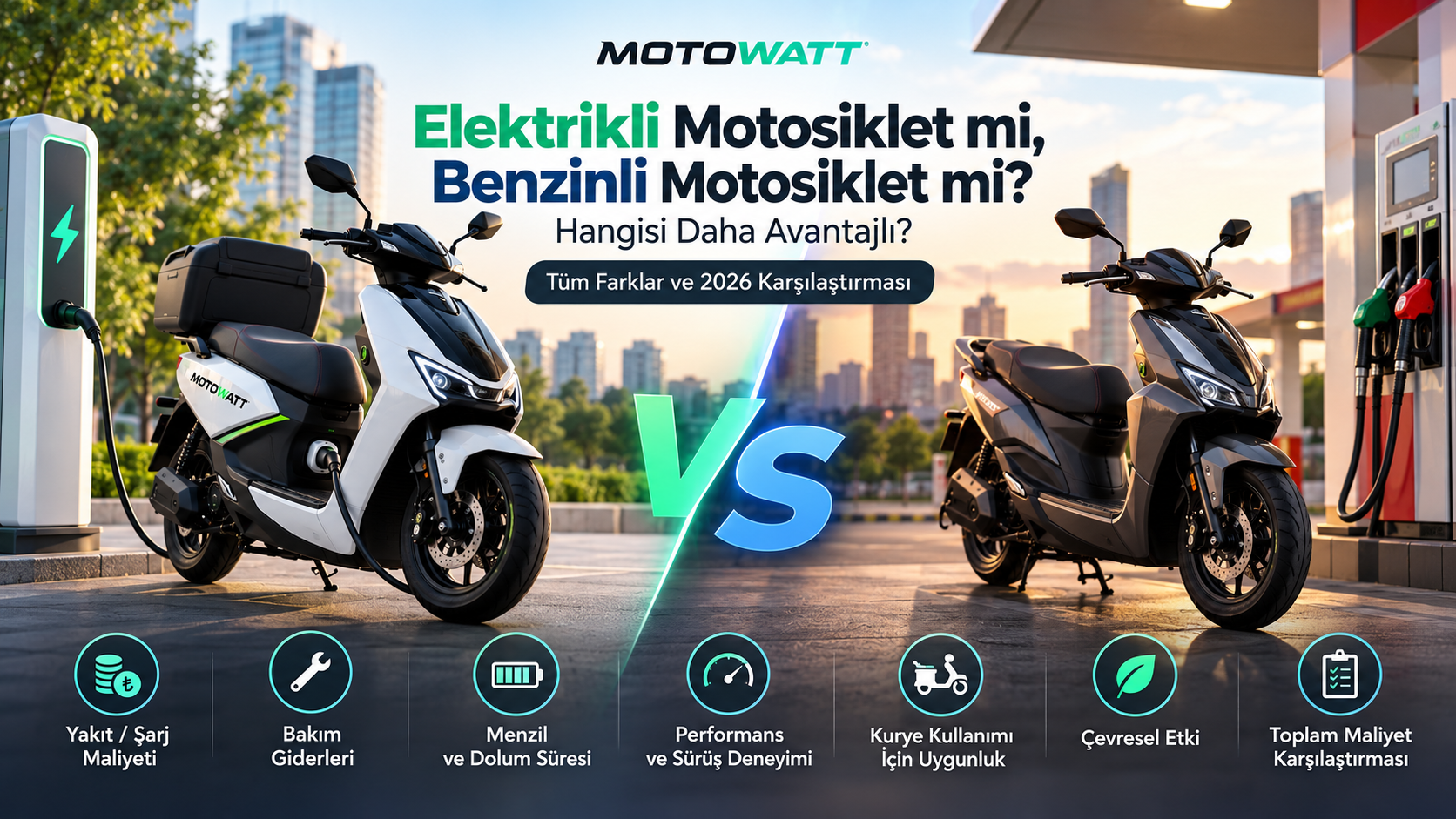
One of the most important decisions when buying a motorcycle is choosing between an electric and a petrol-powered model. Particularly for urban commuting, daily transportation, and delivery services, this decision can directly affect running costs, riding comfort, and daily planning.
So, is an electric motorcycle better than a petrol motorcycle? Which one costs less to run? What are the maintenance advantages of electric motorcycles? And which option performs better in terms of range and riding experience?
In this guide, we compare electric and petrol motorcycles across several important factors to help you understand which option may be more suitable for your needs.
You can also use the Motowatt Cost Calculator below to compare estimated monthly electricity and petrol expenses based on your riding distance.
What Are the Main Differences Between Electric and Petrol Motorcycles?
Electric motorcycles use energy stored in rechargeable batteries, while petrol motorcycles rely on internal combustion engines.
This fundamental difference affects everything from energy consumption and maintenance requirements to riding characteristics and daily usage.
| Feature | ||
| Energy source | Electricity stored in a battery | Petrol |
| Refuelling | Battery charging | Fuel filling |
| Local exhaust emissions | None | Present |
| Engine oil changes | Not required for the electric motor | Required depending on engine type |
| Riding characteristics | Generally quiet and smooth | Varies by engine design |
| Riding range | Depends on battery and riding conditions | Depends on tank capacity and fuel consumption |
| Energy cost | Depends on electricity prices and consumption | Depends on petrol prices and consumption |
| Maintenance | Generally fewer motor-related maintenance items | More internal combustion engine maintenance items |
Both motorcycle types have their own advantages. The right choice depends on your riding habits, expectations, and intended use.
Which Is More Economical: Electric or Petrol Motorcycles?
Energy expenses are usually one of the first factors considered when comparing electric and petrol motorcycles.
Electric motorcycle consumption is measured in kWh per 100 km, while petrol motorcycle consumption is measured in litres per 100 km.
Let's compare two entirely hypothetical motorcycles.
Electric Motorcycle:
- Electricity consumption: 5 kWh/100 km
- Electricity price: TRY 4/kWh
- Energy cost per 100 km: TRY 20
Petrol Motorcycle:
- Petrol consumption: 3 litres/100 km
- Petrol price: TRY 55/litre
- Fuel cost per 100 km: TRY 165
In this example, the electric motorcycle has a lower energy cost per 100 kilometres.
However, these figures are illustrative rather than current market prices or verified consumption figures for specific Motowatt models. Actual expenses vary depending on vehicle specifications, electricity tariffs, petrol prices, riding conditions, and charging losses.
Moreover, overall economic value depends on more than energy expenses. Purchase price, maintenance, insurance, battery-related expenses, and other ownership costs should also be considered.
Electric vs Petrol Motorcycle Cost Calculator
If you use your motorcycle for daily commuting or professional delivery services, your monthly riding distance can significantly influence your energy expenses.
How much could the running cost difference be based on your own riding habits?
Enter electricity and petrol prices, consumption figures, and your monthly distance into the Motowatt Cost Calculator below to compare your estimated expenses.
The calculator compares energy and fuel expenses based on the values you enter. It does not include purchase price, maintenance, insurance, battery replacement, or other ownership expenses.
What Are the Maintenance Advantages of Electric Motorcycles?
Electric motorcycles do not have internal combustion engines. As a result, they do not require certain maintenance items associated with petrol engines, such as engine oil, spark plugs, and some fuel system components.
This can simplify maintenance and reduce certain engine-related servicing expenses on some models.
However, electric motorcycles are not maintenance-free.
Electric motorcycles still require regular inspection of:
- Tyres
- Braking systems
- Suspension
- Electrical connections
- Battery systems
- Lighting and safety equipment
Petrol motorcycles may require additional maintenance, including engine oil changes, air filters, spark plugs, and other engine-specific servicing.
An accurate maintenance cost comparison should be based on the manufacturers' maintenance schedules and actual service prices for the motorcycles being compared.
Which Has a Longer Range: Electric or Petrol Motorcycles?
Riding range is one of the most important factors when choosing a motorcycle.
For electric motorcycles, range depends on battery capacity, energy consumption, riding speed, road conditions, and carried weight.
For petrol motorcycles, fuel tank capacity and fuel consumption are the main factors.
Petrol motorcycles can offer practical advantages for long-distance journeys thanks to widespread fuel station availability and relatively quick refuelling.
Electric motorcycles may be well suited to urban journeys where daily distances are predictable and convenient charging facilities are available.
Therefore, rather than focusing only on the manufacturer's advertised range, consider how many kilometres you actually need to travel under real-world conditions.
Charging Time vs Refuelling Time: Which Is More Convenient?
Refuelling a petrol motorcycle can generally be completed relatively quickly.
Charging an electric motorcycle takes longer in many situations, and the required time depends on battery capacity, charger power, current battery level, and the battery management system.
Charging time is therefore an important factor when choosing an electric motorcycle.
On the other hand, the ability to charge a motorcycle while it is not being used may simplify daily planning for some riders.
To estimate your charging time, explore our guide “How Long Does It Take to Charge an Electric Motorcycle?” and use the interactive Motowatt Charging Time Calculator.
Electric vs Petrol Motorcycle Performance
Depending on their design, electric motors can deliver strong torque from low speeds. This can provide smooth acceleration in stop-and-go urban traffic.
Petrol motorcycles have different power and torque characteristics depending on engine displacement, design, and transmission.
However, being electric or petrol-powered does not automatically make a motorcycle faster or more powerful.
A meaningful performance comparison should consider:
- Motor power
- Torque
- Maximum speed
- Acceleration
- Vehicle weight
- Load capacity
- Riding conditions
For an accurate comparison, examine the technical specifications of motorcycles in similar vehicle categories.
Which Is Better for Urban Commuting?
For urban riding, practicality, comfort, and daily operating costs are especially important.
Electric motorcycles can be attractive for city transportation because of their quiet operation, lack of local exhaust emissions, and potentially lower energy expenses.
Petrol motorcycles may offer greater flexibility thanks to quick refuelling and the widespread availability of fuel stations.
Electric motorcycles may be particularly suitable for riders with predictable daily routes and reliable access to charging.
In contrast, petrol motorcycles may be more convenient for longer or unpredictable journeys where charging access is limited.
Electric vs Petrol Motorcycles for Delivery Riders
Choosing a motorcycle for courier and delivery operations involves different considerations from personal transportation.
Daily mileage, delivery frequency, carried weight, available breaks, and operating costs all influence the decision.
Electric delivery motorcycles may be suitable for operations with predictable daily routes and effective charging arrangements.
Their energy costs can be estimated based on usage, while the absence of certain internal combustion engine maintenance requirements may offer operational advantages.
Petrol delivery motorcycles, on the other hand, may be more practical for long working hours, unpredictable routes, and operations requiring quick refuelling.
When choosing a delivery motorcycle, consider:
- Average daily mileage
- Real-world riding range
- Charging or refuelling time
- Load capacity
- Rider ergonomics
- Maintenance and service support
- Total operating costs
For more information, read our guide “What to Look for When Buying an Electric Delivery Scooter.”
Environmental Impact of Electric and Petrol Motorcycles
Electric motorcycles produce no exhaust emissions while being ridden. This is an important distinction, particularly for urban air quality.
However, the environmental impact of electric motorcycles should not be assessed solely during operation.
Electricity generation, battery production, material use, and vehicle lifespan all contribute to the overall environmental footprint.
Petrol motorcycles also have environmental impacts associated with fuel production, distribution, and combustion.
A comprehensive comparison therefore requires considering the environmental effects of both motorcycle types throughout their life cycles.
Which Is Better in the Long Run?
To determine whether an electric or petrol motorcycle is more economical over time, it is important to consider the total cost of ownership.
Total ownership costs may include:
- Purchase price
- Electricity or petrol expenses
- Maintenance and servicing
- Insurance
- Tyres and consumable parts
- Battery or other major component replacements
- Resale value
For example, even if an electric motorcycle has lower energy expenses, its purchase price and other costs may affect the overall financial result.
The most meaningful comparison is therefore based on the total expenses of two motorcycles with similar intended uses over a defined ownership period.
Discover Motowatt Electric Motorcycle Models
When choosing an electric motorcycle, it is important to evaluate energy consumption, range, charging time, performance, and intended use together.
Explore Motowatt's electric motorcycle models, compare their technical specifications, and discover options that may suit your daily commuting or professional delivery requirements.
Explore Motowatt Electric Motorcycle Models
Frequently Asked Questions
Is an electric motorcycle cheaper to run than a petrol motorcycle?
Electric motorcycles may offer lower energy expenses in certain situations. However, total ownership costs depend on purchase price, maintenance, insurance, battery-related expenses, and other factors.
Do electric motorcycles cost less to maintain?
Electric motorcycles do not require some maintenance procedures associated with internal combustion engines. However, brakes, tyres, suspension, batteries, and other components still require attention. Actual maintenance costs depend on the model.
Are electric motorcycles suitable for delivery riders?
Electric motorcycles can be suitable for delivery operations when daily mileage, carrying capacity, range, and charging arrangements meet operational requirements.
Can you use an electric motorcycle for long-distance journeys?
This depends on the motorcycle's range, performance, charging infrastructure, and planned route. Long-distance travel requires consideration of charging locations and necessary stops.
Are electric motorcycles faster than petrol motorcycles?
Speed and acceleration depend more on power, torque, weight, and vehicle design than on the type of energy source. Compare technical specifications of motorcycles in similar categories.
How do you calculate the monthly cost of an electric motorcycle?
You can estimate monthly energy expenses using your riding distance, electricity consumption, and electricity unit price. The Motowatt Cost Calculator in this article also allows you to compare these expenses with those of a petrol motorcycle.